From Christmas to New Year: Mini Excavator Usage Trends
Christmas has just passed, but construction sites haven't stopped.
From Christmas to New Year's, it's an easily overlooked yet very real usage phase for excavators. As the holiday atmosphere fades and project schedules gradually resume, the way excavators are used and the focus of attention shifts.
This isn't a story about promotions or deliveries, but about "how excavators are being used in real-world working conditions."

In the post-holiday period, excavators are appearing more frequently in daily operations. During the Christmas season, many projects slowed down or were suspended, but starting in the first week after the holidays, excavators are often put back into use in a more "basic" way.
Site preparation, pipeline preparation, simple excavation and clearing work, and preliminary preparation for new projects.
These seemingly simple tasks place higher demands on the stability and operability of the equipment. Excavators don't need to perform at full capacity, but they need to be "ready to use at any time and easy to operate."
Low-temperature environments make the true performance of excavators more apparent.
From Christmas to New Year's, low-temperature environments become the norm. Compared to the high-intensity construction during peak season, this period more easily exposes differences in the details of the equipment.
Many users begin to pay more attention to:
Smoothness of cold starts
Stability of hydraulic system response
Reliability after long periods of inactivity
Ease of operation and reduced fatigue.
These factors are often repeatedly tested in the post-holiday period and directly affect users' overall evaluation of the equipment.
The Presence of Small and Compact Excavators is Rising
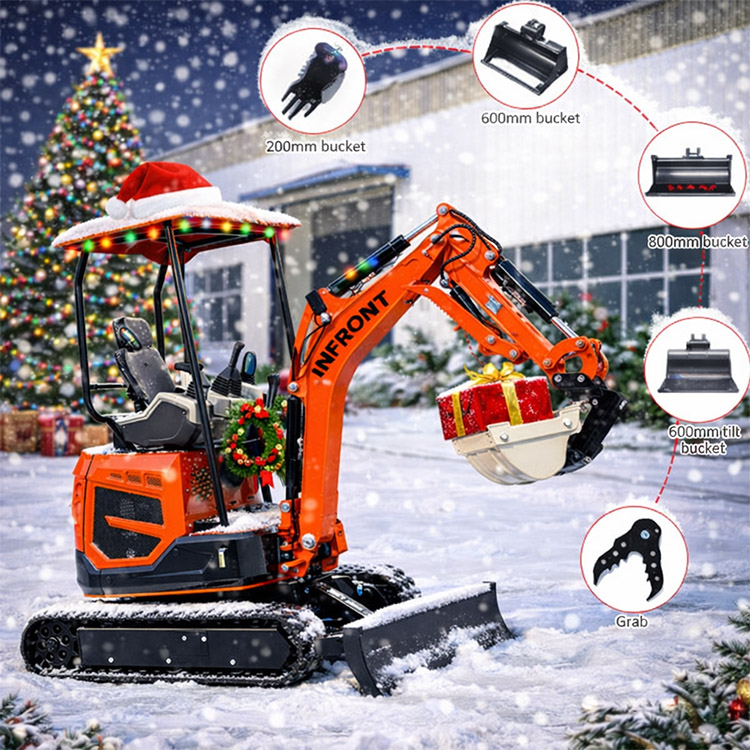
In the post-holiday usage scenario, large-scale continuous construction projects are less common; instead, scattered and distributed operations are more prevalent. This makes the advantages of small and compact excavators even more apparent.
They can more easily enter and exit confined spaces.
They have lower site requirements.
They require less preparation time and are ready to go immediately.
They are more suitable for individual users and small teams.
During this period, excavators are no longer just "large-scale engineering equipment," but are regarded as efficient and reliable everyday tools.
Post-holiday use emphasizes "ease of use" rather than "extreme performance."
Unlike the peak construction season, user expectations for excavators have changed from Christmas to New Year's.
Compared to extreme digging capabilities, users value more:
Intuitive operation
Easy maintenance
Controllable failure rate
Suitable for long-term, intermittent use
This change is also driving the selection of excavators to gradually shift from "parameter-oriented" to "user experience-oriented."
Preparing for the New Year, Excavators are Entering a Phase of Re-planning
From Christmas to New Year's, many users are planning their projects for the coming year. Whether an excavator is suitable for continued use, and whether it needs replenishment or upgrading, is often seriously discussed at this stage.
For users, this is not an impulsive decision, but a judgment based on real-world usage feedback.
During the transition from Christmas to the New Year, excavators are returning to their most authentic role—stable, reliable, and readily available.
It is precisely in these unexaggerated daily working conditions that the value of excavators is continuously validated, laying the foundation for usage trends in the new year.