How to choose a suitable robotic lawnmower?
For homeowners with flat, open lawns, traditional automated lawnmowers might seem like a good option. However, real-world yards often present challenges: steep slopes, tangled trees, scattered toys, and even paths that pets might cross at any moment. In these complex scenarios, fully automated robots often fall short and can even pose safety hazards.
In recent years, intelligent remote-controlled lawnmowers have rapidly become a favorite among gardening enthusiasts and professional landscape architects. It's not just an upgrade in tools, but a revolution in lawnmowing concepts.
Many users fall into the misconception that "fully automatic is best" when choosing lawnmowers. However, the reality is that existing automatic navigation technologies (whether perimeter-based or visual navigation) often face risks of slipping, tipping over, or failing to cover slopes exceeding 30%. Not to mention those requiring frequent navigating narrow passages or multi-zoned yards, where the setup process itself can be a nightmare.
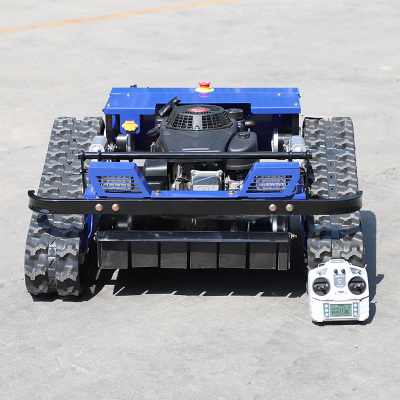
This is where the advantages of a remote-controlled lawnmower become clear. It returns control to the user while retaining the machine's powerful performance.
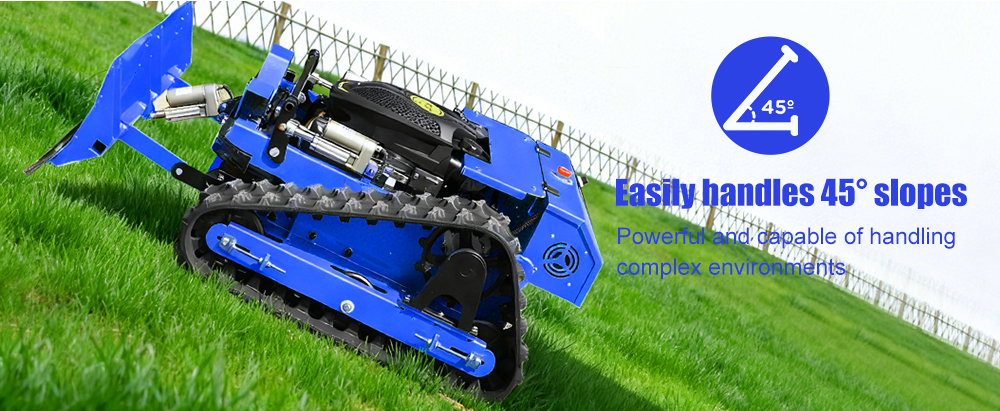
Core Advantage 1: Conquering Steep Slopes, Safety First
For hilly yards, safety is always paramount. Traditional push lawnmowers are not only strenuous to operate on steep slopes but also pose a risk of slipping or being crushed by the machine.
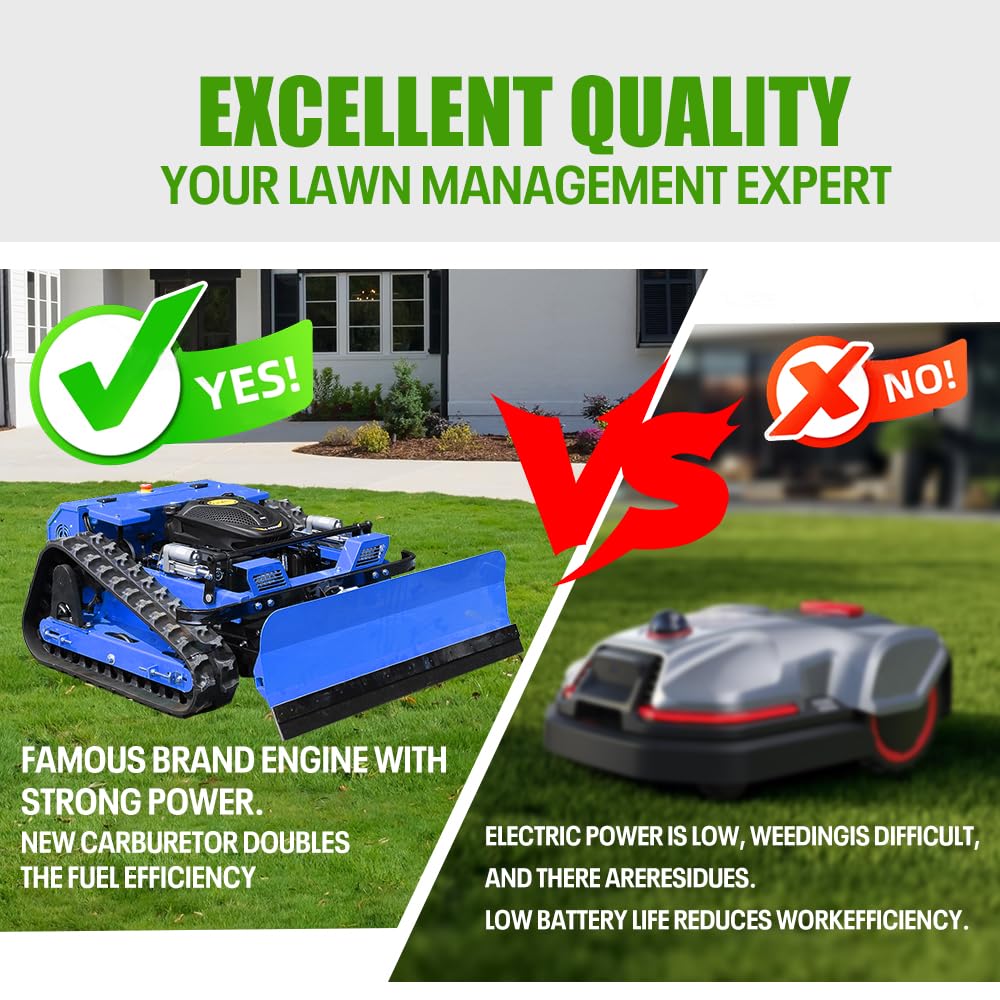
Modern high-end remote-controlled lawnmowers are designed for extreme terrain. They are typically equipped with four-wheel or tracked drive systems and low-center-of-gravity chassis, easily handling slopes up to 45% or even steeper. Users simply need to stand in a safe, flat area and precisely control the machine up and down slopes using a remote control or mobile app. This "human-machine separation" operation mode completely eliminates the safety hazards of personnel working on slopes, making the once daunting "dead corners" easy to manage.
Core Advantage Two: Zero Installation Barrier, Ready to Use Immediately
Unlike traditional automated lawnmowers that require perimeter markings and hours of map calibration, remote-controlled lawnmowers offer unparalleled convenience.
No Wiring Required: No need to dig trenches or bury wires in the lawn, preserving the integrity of the landscape.
No Complex Mapping Required: No tedious GPS signal waiting or LiDAR initialization processes.
Instant Response: Simply plug it in, charge it, and it's ready to go.
For families with multiple, scattered lawn areas or frequently changing yard layouts (e.g., moving children's playground equipment, temporary storage), remote-controlled lawnmowers offer unparalleled flexibility. Control it to mow wherever you want, completely free from the constraints of virtual walls or physical wiring.
Choose the right tool, not the most expensive technology.
When choosing lawn mowing equipment, blindly pursuing "complete automation" may not be the optimal solution. Remote-controlled lawnmowers strike a perfect balance between "human input" and "operational efficiency/safety."
They are particularly suitable for: Homeowners with yards featuring steep slopes, ditches, or irregular terrain; Landscape maintainers who do not wish to damage lawn perimeter lines; Users who need to manage multi-area, complex obstacle environments; Families with extremely high safety requirements (especially those with pets and children).
In this era of rapid technological advancement, the most suitable tools are not those machines that attempt to completely replace humans, but rather partners that allow humans to complete tasks more safely and easily. Remote-controlled lawnmowers are an outstanding example of this philosophy.